International Certifications & Test Reports Download Instantly
All test reports issued by STQ Testing Services Co., Ltd. — an accredited third-party laboratory. Authentic, complete, ready to share with your customs broker, buyer or compliance team.
All Certificates from Accredited Third-Party Lab
Every test report is issued by STQ Testing Services Co., Ltd. (Building 1, 15 Yinzhu Road, High-new district, Suzhou, China 215129). STQ is ISO 17025 accredited. Reports include full test methodology, results, and engineer signatures — not just certificate images.
FDA
FDA 21 CFR Compliance
US Food & Drug Administration
🇺🇸 USAAmazon USUS Retail
Tests food contact materials compliance per FDA 21 CFR 177.1520 (density, melting point, extractable fraction) and FDA 21 CFR 177.2600. Total chromium content — Suitable for contact with food. Covers all stainless steel bottles and mugs.
Tests extractable heavy metals per German Food, Articles of Daily Use and Feed Code (LFGB), Section 30, and Technical Guide on Metals and Alloys used in food contact materials (1st edition 2013). Covers all stainless steel series.
General requirements per EU Regulation No. 1935/2004, Article 3. Full migration testing for vacuum bottles (all TI and TA series). Tests conducted on behalf of Italian buyer GET IMPRESSED SRL — demonstrates compliance for EU import and retail.
Phthalates content per US California Prop 65, AB 1108:2007, CPSIA section 108 — PASS. Lead (Pb) and Cadmium (Cd) content per CA Prop 65. FDA 21 CFR 177.1520 density/extractable fraction — PASS. Required for Amazon US listings and California retail sales.
GRS V4.0 certification (License No. 220880) for packaging materials: 100% recycled post-consumer PE (polyethylene), PS (polystyrene), and PET (polyethylene terephthalate). Enables our clients to make verified recycled content claims in marketing and ESG reporting.
Passed Hallmark's rigorous Function Reliability Test (CPSD-HL-01026, CPSD-HL-01014, CPSD-GB-01058) at Hallmark DG Lab. Test includes: Age & Humidity test, Dishwasher test, Thermal function test, Function test (25 cycles), UPC scannability. Result: ACCEPT. Ultimate proof of quality for US retail.
Appointed by Sanrio Southeast Asia (Agreement M202408-1887) as an authorized sub-licensee to produce Hello Kitty, My Melody, Kuromi and Little Twin Stars character drinkware — mugs and bottles with full-wrap character artwork approved to the licensor's brand guide. Food-safe and retail-ready. Commercially sensitive shipment and product details are redacted in this public copy.
Our bamboo fibre cups and bottles are separately tested. STQ report SZ2022041426-1E (May 2022, test model Bamboo-1008, covering all cups and bottles made from bamboo fibre) confirms overall migration and soluble heavy metals to EU Regulation 10/2011, plus Article 3 of EU 1935/2004. Our bamboo fibre is bound with corn starch — the formulation contains no melamine and no melamine-formaldehyde resin, which is the source of the formaldehyde concern in bamboo composite tableware; a melamine and formaldehyde migration test can be commissioned for your compliance file on request. The material is rated to 70 °C and is hand-wash only. Note the report above is a food-contact safety report, not a compostability certificate — EN 13432 / ASTM D6400 testing can be arranged per formulation.
Our factory operates under a certified ISO 9001 quality-management system covering design, production, inspection and shipping — the system-level standard behind every order, not a per-product report.
The TH ceramic-lined series carries dedicated testing on the food-grade ceramic coating: FDA & LFGB food-contact compliance, plus antibacterial (E. coli / S. aureus) and biological-safety reports. Drinks never touch bare metal — no metal taste, no flavour transfer.
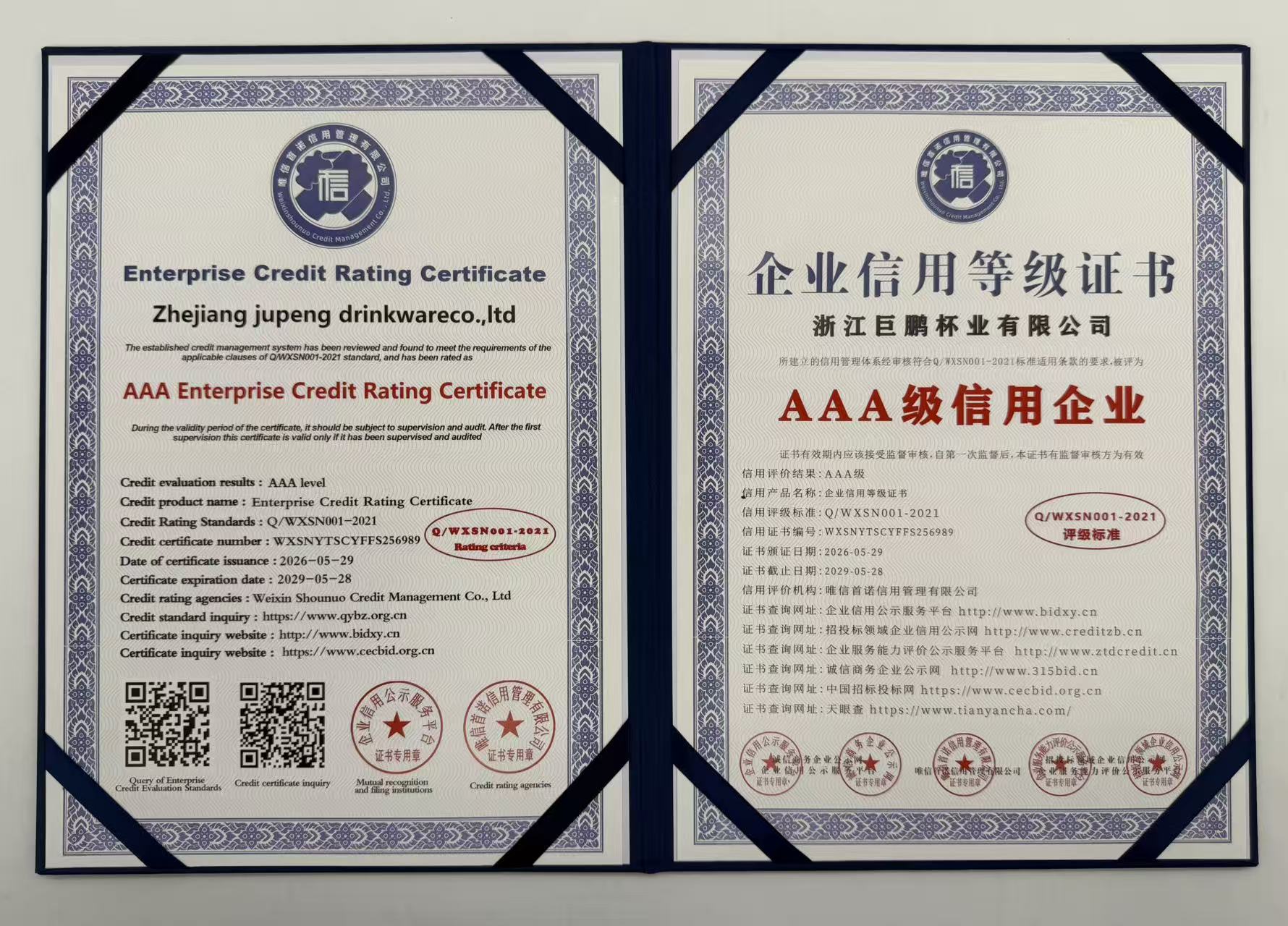
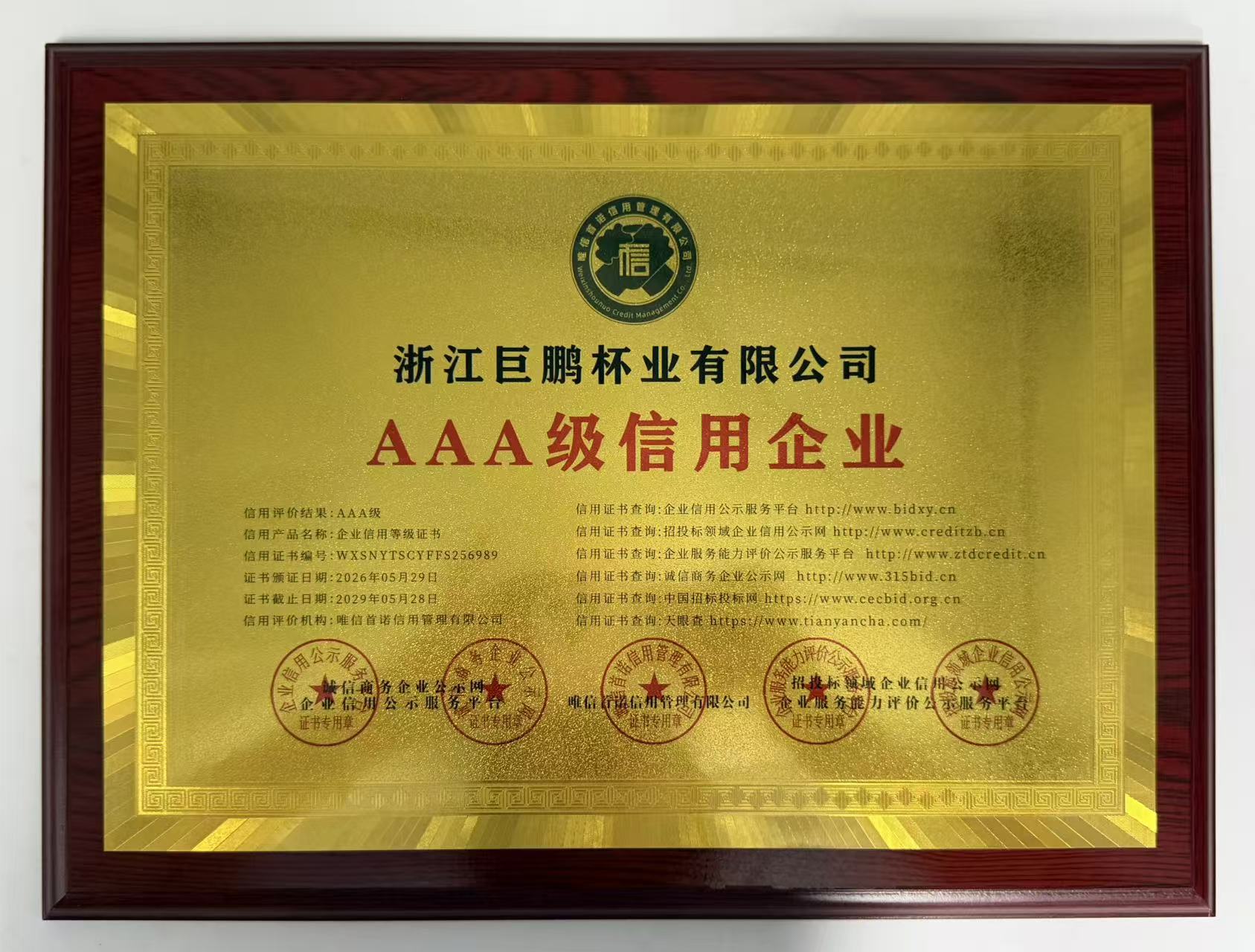
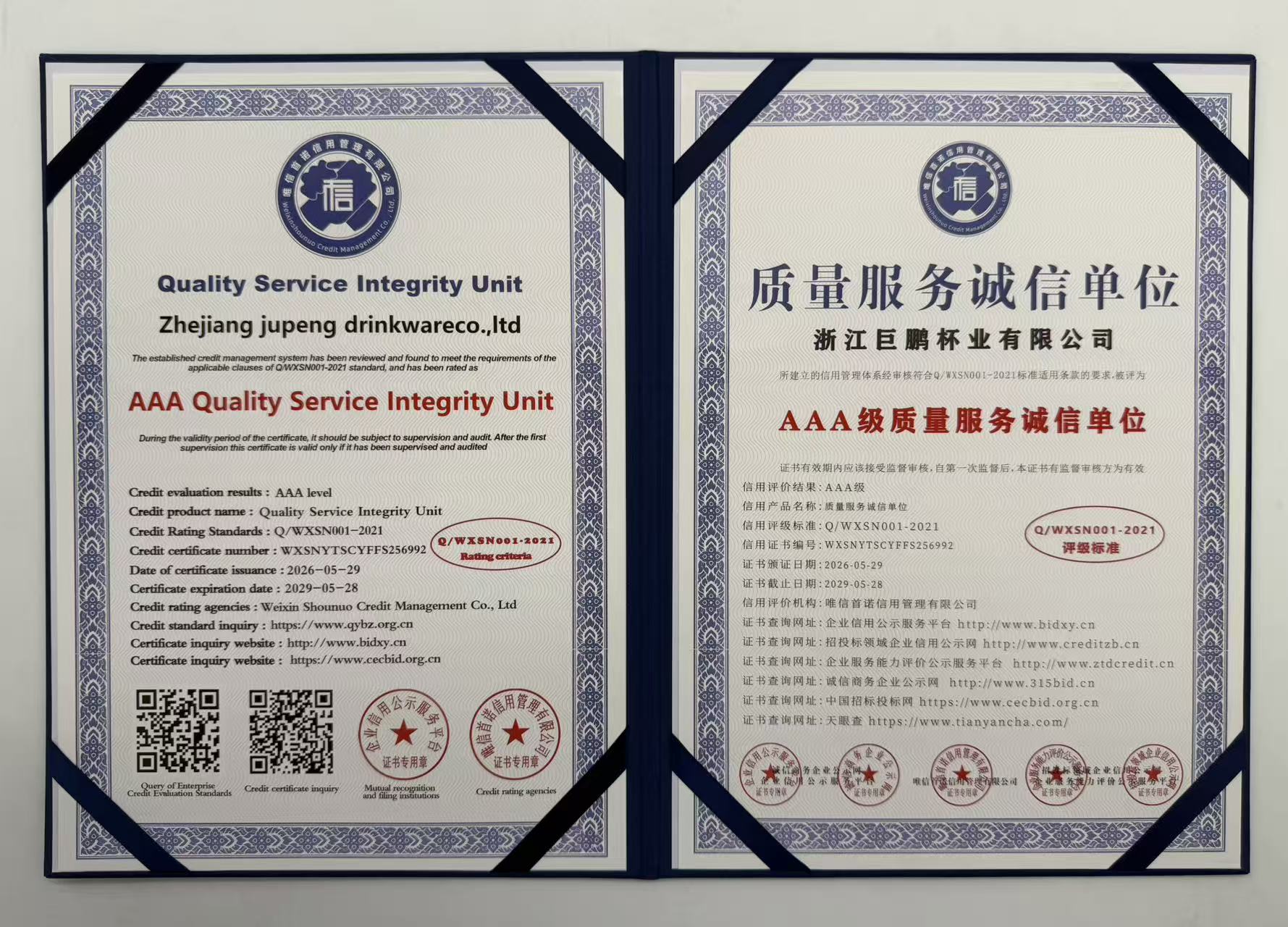
Beyond product testing, Jupeng holds national AAA enterprise-credit and quality-service-integrity ratings — independent proof you are dealing with an established, financially sound manufacturer with a 28-year export record.
Using Our Certificates
How to Use These Documents
Amazon Sellers
Use the FDA + Prop 65 report to respond to Amazon compliance requests. Upload to your listing or Seller Central documentation. Our reports are accepted by Amazon Compliance team.
Retail Buyers
Provide FDA, LFGB, EU and Prop 65 certificates to your retail buyer's compliance department. For European retail, LFGB + EU Reg 1935/2004 together satisfy most requirements.
Customs Brokers
Share certificates with your customs broker to facilitate smooth import clearance. FDA reports are particularly useful for US Customs CBP declarations for food-contact goods.
Need a Specific Certification?
If your market requires additional testing (REACH, RoHS, EN standards, retailer-specific protocols), we can arrange it. Contact us and we'll advise on requirements and timeline.
The single most common question we get is not “are you certified” — it is “which certificate does my market require, and do you already have it”. Those are two different questions, and the honest answer differs per market. Below is what we hold today and what we arrange per order.
Market
What is actually required
Our status
United States
FDA 21 CFR food-contact compliance. For products marketed to children, a CPC (Children’s Product Certificate) backed by CPSIA third-party lab testing — lead, phthalates, small parts.
FDA 21 CFR report on file, downloadable. CPC is issued per product per order — it is not a factory certificate, it is a product certificate, so it has to be tested against your exact SKU.
California
Proposition 65 on top of federal rules, plus CPSIA Section 108 for phthalates.
On file, downloadable.
European Union
Framework Regulation EC 1935/2004 for all food-contact materials, plus EU 10/2011 specific migration for plastic parts (lids, seals, straws).
Complete and on file. Our EU documentation package is downloadable now. If your importer or a retailer asks for migration testing against a specific colourant or a resin we have not run before, we add that test to the order rather than send you a report that does not name your material.
Germany
LFGB, which is stricter than the EU baseline on sensory and migration.
On file, downloadable.
United Kingdom
Post-Brexit this is UKCA, not CE — and for drinkware the relevant route is retained food-contact legislation rather than a CE mark at all. Most drinkware does not carry a CE mark, and a supplier who offers you one for a water bottle is telling you something about their compliance knowledge.
We supply the underlying food-contact test reports that UK importers need. We do not issue CE marks for drinkware, because the product category does not fall under a CE directive.
Recycled-content claims
GRS (Global Recycled Standard) if you intend to state recycled content on pack or listing.
On file since 2022.
Certificates we hold versus certificates we arrange
This distinction matters more than most suppliers admit, so we state it plainly:
Held and downloadable now — FDA 21 CFR (US), the full EU package: EC 1935/2004 and EU 10/2011, LFGB (Germany), California Prop 65, GRS, ISO 9001. All issued by STQ Testing Services, an accredited third-party lab, not written by us.
Arranged per order — CPC / CPSIA for children’s products, REACH SVHC screening, RoHS, EN standards, and retailer-specific protocols such as Walmart or Target supplier requirements. Also any migration test against a colourant or resin outside what we already hold on file.
If a report you need is in the second group, we arrange the testing rather than tell you we already have it. Our materials meet the standards — 304 and 316 stainless, food-grade PP and Tritan, silicone seals, all from the same supply chain that passed the reports above — but a certificate naming your SKU has to be tested against your SKU. Testing typically takes 7–15 working days and is quoted separately; on repeat orders of the same specification it does not repeat.
Ask us before you commit to a launch date. The compliance step is the one that most often surprises first-time importers, and it is easier to plan for than to recover from.
What changed in the EU in 2025–2026
Three regulatory changes since the start of 2025 affect drinkware directly — and the third one catches buyers out because it is about the box, not the bottle. If you are working from a compliance checklist written before 2025, both are missing from it.
Change
What it does
What it means for your order
BPA ban — Regulation (EU) 2024/3190 In force 20 Jan 2025
Bans BPA, its salts and other hazardous bisphenols (BPS, BPAF, TBBPA among them) in the manufacture of food-contact plastics, coatings, printing inks, adhesives, silicones and rubber. Amends EU 10/2011 and repeals the old 2018/213.
Deadlines you should have in your calendar: non-compliant repeat-use articles could only be placed on the market until 20 July 2026, and stock already placed may remain on sale until 20 January 2029. A supplier still working from a pre-2025 spec is selling you a problem with a date on it. Our plastic components are BPA-free by formulation — PP, Tritan and food-grade silicone — and we supply a Declaration of Compliance stating BPA was not used.
GPSR — Regulation (EU) 2023/988 Applies from Dec 2024
The General Product Safety Regulation. Not drinkware-specific, but it applies to consumer drinkware: risk assessment, a technical file, traceability, and an EU-based responsible person.
This one catches importers by surprise because it is not a test report — it is a file you have to keep, and an economic operator inside the EU who is accountable for it. We supply the underlying documentation (material declarations, test reports, batch traceability); the technical file and the responsible person are yours to hold.
Packaging rules — PPWR, Regulation (EU) 2025/40 In force 11 Feb 2025, applies from 12 Aug 2026
Covers all packaging, not the product: colour boxes, sleeves, inserts, hang tags and shipping cartons. Sets heavy-metal limits for packaging, restricts PFAS in food-contact packaging, and requires recyclability criteria and minimum recycled content over time.
If your drinkware ships in a printed colour box, the box is now in scope as well as the bottle. We can supply a packaging compliance file: heavy-metals test on the packaging, PFAS screening where the pack contacts food, and importer details printed on the pack. Worth raising with us before box artwork is finalised — importer details and recyclability marks take space that has to be designed in, not squeezed on later.
One rule that is often quoted at us but does not apply: the Single-Use Plastics Directive (EU) 2019/904 tethered-cap requirement — caps must stay attached to the container. It covers single-use plastic beverage containers up to 3 litres, tested to EN 17665. Reusable drinkware is outside its scope, so a stainless flask, a Tritan sports bottle or a glass tumbler does not need a tethered lid to enter the EU. If a buyer or an agent tells you otherwise, they have applied a packaging rule to a durable product.
The rest of the world, market by market
Compliance is not one global standard. Below is what actually applies in the markets we ship to most, with the dates that matter in 2026. If your market is not listed, ask — we would rather check than guess.
Market
What governs food contact
Dates and details worth planning around
United States
FDA under the FD&C Act. No positive list — substances must be safe for intended use rather than pre-approved.
FDA Prior Notice must be filed before importation, including for sport bottles, with the product code declared on entry (VEOE for plastic, VGNM for glass). This catches first-time importers more often than any test report does. State-level PFAS bans are separate from federal rules and their effective dates vary between 2025 and 2027 — California, New York and Washington among them.
Canada
Health Canada under the Food and Drug Regulations, plus the Canada Consumer Product Safety Act. No positive list.
Glazed Ceramics and Glassware Regulations (SOR/2016-175) set lead and cadmium leachability limits for cups, mugs and hollowware, tested to ISO 6486-1:2019 or ASTM C927. Surface Coating Materials Regulations (SOR/2016-193) restrict lead and cadmium in coatings — relevant if your bottles are powder-coated and aimed at children. Single-Use Plastics Prohibition Regulations (SOR/2022-138) ban single-use plastic straws and foodservice ware; a reusable straw supplied with a bottle sits outside it, but the packaging is worth checking. The Prohibition of Certain Toxic Substances Regulations, 2025 (SOR/2025-270) comes into force 30 June 2026, replacing the 2012 version — PFOS, PFOA and LC-PFCAs, with importer records kept for five years. Bilingual English/French labelling applies to the retail pack.
Mexico
COFEPRIS under the Ministry of Health. No positive list, unlike MERCOSUR.
NOM-231-SSA1-2016 is mandatory for glazed pottery, ceramics and glassware in food contact — testing by designated labs and certification before market release, not after. If your order includes ceramic or glass items, this is a lead-time item, not a paperwork item.
Labelling is the part that catches importers out.NOM-050-SCFI-2004 sets the commercial information required on the pack — product name, importer name and RFC tax ID, country of origin, quantity in metric units — all in Spanish. NOM-051-SCFI/SSA1-2010 applies where the item is prepacked with food or drink. For metal food and beverage containers, NOM-002-SSA1-1993 prohibits lead solders and specifies permitted seam types. Heavy metals are commonly assessed against NOM-225-SCFI-2019 (lead ≤0.05%, cadmium ≤0.01%) — written for cookware but routinely referenced for drinkware. Send us your importer details early: the RFC and Spanish text have to be designed into the label artwork, not added at the port.
MERCOSUR Argentina, Brazil, Paraguay, Uruguay
Harmonised food-contact rules via GMC Resolutions, with a positive list of monomers and additives.
GMC Res. 19/21 (plastics): overall migration limit 10 mg/dm², specific limits for metal salts, and no detectable primary aromatic amines from printed or coated surfaces — that last one directly concerns decorated drinkware. GMC Res. 34/25 (Dec 2025) adds a positive list and metal limits for silicones. National transposition deadline for both: 16 June 2026. Brazil has already transposed via ANVISA; the others are in process.
Southeast Asia
ASEAN general guidelines on top of national frameworks — harmonised in principle, separate in practice.
Singapore’s Food (Amendment) Regulations 2025 take effect 30 January 2026: English labelling, usage instructions, manufacturer contact, traceability and a Declaration of Compliance. Malaysia’s Food (Amendment) Regulations 2026 take effect 1 August 2026, with new lead and cadmium migration limits for ceramic items tested on four identical specimens per product.
Australia & New Zealand
FSANZ — a single harmonised market. Standard 1.4.3 is performance-based rather than a positive list, referencing AS 2070 for plastics.
Standard 1.1.1-10 sets a physical safety requirement most compliance lists miss: packaging and food-contact articles must not be capable of being swallowed or obstructing an airway. For drinkware this bears on small parts — straw tips, valves, seals. New Zealand adds a durability requirement for reusable packaging under the Food Act 2014.
Two patterns worth taking away. First, markets split into positive list systems (EU, MERCOSUR — a substance must be on the approved list) and performance-based systems (US, Canada, Mexico, Australia — a substance must simply be safe for use, and you carry the burden of showing it). A report written for one system does not automatically satisfy the other. Second, 2026 is an unusually dense year for deadlines: MERCOSUR transposition on 16 June, Canada’s toxic substances regulations on 30 June, Malaysia on 1 August, and the EU BPA repeat-use cutoff on 20 July. If you are planning orders into any of these markets, check the date before you check the price.
Temperature-display lids: the battery paperwork that ships with them
A flask with a temperature-display lid contains a CR2032 lithium button cell, and that single small component changes what the shipment needs. Lithium cells are UN3091 dangerous goods; without the right documents a container can be refused at the port of loading rather than at the destination, which is a far more expensive place to discover the problem.
Three documents are required, and they work as a set — a forwarder who accepts two of the three is storing up a problem:
Document
What it proves
Download
UN 38.3 test report No. 1125020210
The cell passed all seven UN Manual of Tests and Criteria section 38.3 tests: altitude simulation, thermal, vibration, shock, external short circuit, crush and forced discharge. CR2032, 3 V, 210 mAh, lithium content 0.062 g. Issued by Shanghai Institute of Chemical Industry Testing (CNAS L0748, CMA 230014349552), effective 24 March 2025.
Assessed under the IMDG Code (2024 edition, the version in force for this classification). Because the cell falls within Special Provision 188, the article is not subject to the other IMDG provisions — packages up to 30 kg, 1.2 m drop test passed. This is the document your forwarder actually asks for. Effective 1 January 2026.
Material safety data sheet under UN Recommendations on the Transport of Dangerous Goods, ST/SG/AC.10/1 Rev. 23. Required by most carriers and by customs in several markets even when Special Provision 188 applies.
Whose documents these are: the cell is made by our battery supplier, not by us, so the reports are issued in the battery manufacturer’s name — that is how it works throughout the industry and your forwarder will expect it. We hold the current set and send it with the shipping documents. If a supplier offers you a UN 38.3 report in their own name for a battery they did not manufacture, ask who actually tested it.
Two practical points before you order a display lid. First, the packages must carry the lithium battery mark — we apply it, but tell us if your own carton artwork needs to accommodate it. Second, air freight is a different regime from sea: the documents above cover sea transport under IMDG, and an air shipment needs the IATA route assessed separately. If your order might move by air, say so at enquiry rather than at booking.
When a requested certificate does not apply to drinkware at all
Roughly once a month a buyer sends us a certificate list copied from another category — usually from an electronics, textile or toy brief — and asks whether we can supply it. Sometimes we can. Often the honest answer is that the certificate does not exist for a drinking vessel, and saying so is more useful than quietly finding something that looks similar.
Sometimes requested
What it actually covers
What applies to drinkware instead
CE marking
Electrical equipment, toys, machinery, PPE, medical devices. A drinking vessel falls under none of these directives.
Food-contact evidence: EC 1935/2004 and EU 10/2011. A supplier offering a CE certificate for a water bottle is telling you something about their compliance knowledge.
UKCA marking
The post-Brexit equivalent of CE — same directive scope, so the same answer: drinkware is outside it.
Retained UK food-contact legislation, evidenced by the same test reports.
RoHS
Hazardous substances in electrical and electronic equipment.
Only relevant if your item has electronics — a temperature-display lid, for instance. A plain vacuum flask has none. We arrange RoHS for the electronic part when there is one.
OEKO-TEX
Textiles and their chemical residues.
Applies only to a fabric component, such as a bottle sleeve or a carry pouch — not to the bottle itself.
NSF
Commercial foodservice equipment and water-treatment products.
Rarely required for consumer drinkware. If a US institutional buyer asks, we can arrange it, but check first whether their specification actually calls for it.
ISO 22000 / HACCP
Food production safety management — for companies making food, not containers.
ISO 9001 for quality management, plus food-contact material reports. We hold ISO 9001.
If a certificate on your list is not on either table above, send it to us before you build it into a contract. We will tell you whether it applies, whether we hold it, or whether it belongs to a different product category — and if it genuinely applies and we do not yet hold it, we arrange the testing. What we will not do is send you a document that looks official but does not cover what your customs officer or your retailer is actually asking about.
Compliance questions importers actually ask
Can you ship flasks with temperature-display lids by sea, and what paperwork comes with them?▾
Yes, routinely. A display lid contains a CR2032 lithium button cell, which makes the shipment UN3091 dangerous goods — and that is decided at the port of loading, not at your end, so the documents have to be right before the container moves. Three travel with every order and they work as a set: the UN 38.3 test report (all seven tests passed, lithium content 0.062 g), the sea transport classification under IMDG Code 2024 confirming the cell falls within Special Provision 188 (so it is not subject to the other IMDG provisions, packages up to 30 kg), and the MSDS. All three are downloadable above. A forwarder who accepts two of the three is storing up a problem for you. One caveat: these cover sea freight. Air is a separate regime under IATA — tell us at enquiry if the order might fly.
Are the battery certificates in Jupeng’s name?▾
No, and they should not be. The cell is manufactured by our battery supplier, so the UN 38.3 report, the transport classification and the MSDS are issued in the battery manufacturer’s name by an accredited lab — in this case Shanghai Institute of Chemical Industry Testing (CNAS L0748, CMA 230014349552). That is standard across the industry and your forwarder expects it. What we do is hold the current set, check it has not expired, and send it with the shipping documents. If a supplier hands you a UN 38.3 report in their own name for a cell they did not make, ask who actually performed the test — the report number is traceable to the issuing lab.
Do I need FDA Prior Notice to import water bottles into the US?▾
Yes — and it is the step that catches first-time importers most often, because it is not a test report and no supplier certificate covers it. FDA Prior Notice must be filed online before the shipment arrives, and it applies to food-contact articles including sport bottles. The product code goes on the entry: VEOE for plastic, VGNM for glass. Your customs broker normally files it, but the responsibility is the importer’s, not ours. We supply the material and test documentation that supports the entry; tell us at order stage if your broker needs anything in a particular format.
What applies in Brazil and the rest of MERCOSUR?▾
MERCOSUR (Argentina, Brazil, Paraguay, Uruguay) runs a positive list system, unlike the US or Mexico — a substance has to be on the approved list, not merely safe. For plastics, GMC Resolution 19/21 sets an overall migration limit of 10 mg/dm², specific limits for metal salts, and no detectable primary aromatic amines from printed, coated or adhesive surfaces — which concerns decorated drinkware directly, since it covers the print rather than the bottle. GMC Resolution 34/25 (December 2025) adds the same treatment for silicones, including the seals in a flask lid. National transposition deadline for both is 16 June 2026; Brazil has already transposed via ANVISA. If you are shipping decorated bottles into Brazil, raise the PAA requirement with us at artwork stage rather than after production.
Which 2026 compliance deadlines should be in my calendar?▾
Four, and they are close together: 16 June 2026 — MERCOSUR national transposition of GMC Res. 19/21 and 34/25. 30 June 2026 — Canada’s Prohibition of Certain Toxic Substances Regulations, 2025 (SOR/2025-270) comes into force, covering PFOS, PFOA and others, with a five-year record-keeping obligation. 20 July 2026 — last date non-compliant repeat-use articles can be placed on the EU market under the BPA ban. 1 August 2026 — Malaysia’s new lead and cadmium migration limits for ceramic items. Add Singapore’s Food (Amendment) Regulations, already in force since 30 January 2026. If your order lands in one of these markets after its date, the specification has to be right before production, not after.
Does the EU BPA ban affect the bottles you make?▾
Our plastic components are BPA-free by formulation — polypropylene, Tritan copolyester and food-grade silicone, none of which use bisphenol A as a raw material — so Regulation (EU) 2024/3190 does not force a change to our materials. What it does change is the paperwork: regulated materials now need a Declaration of Compliance stating BPA was not used in manufacture, and the ban reaches beyond plastics into coatings, inks, adhesives and rubber. Two dates are worth having in your calendar: non-compliant repeat-use articles could only be placed on the market until 20 July 2026, and stock already on the market may remain on sale until 20 January 2029. If a supplier is quoting you from a specification written before 2025, that is worth checking before you commit.
Do my bottles need tethered caps to sell in the EU?▾
Almost certainly not. The tethered-cap rule sits in Article 6 of the Single-Use Plastics Directive (EU) 2019/904 and applies to single-use plastic beverage containers up to 3 litres — the disposable water and soft-drink bottles you buy filled. Compliance is demonstrated against harmonised standard EN 17665. Reusable drinkware is outside its scope: a stainless vacuum flask, a Tritan sports bottle or a glass tumbler does not need a tethered lid to enter the EU. We mention it because buyers are sometimes told otherwise by an agent who has applied a packaging rule to a durable product. If your customer insists, ask which article of 2019/904 they are relying on — the question usually settles it.
What is GPSR and do I need anything from you for it?▾
Regulation (EU) 2023/988, the General Product Safety Regulation, applies to consumer products including drinkware. It surprises importers because it is not a test certificate — it is an obligation you carry: a documented risk assessment, a technical file, batch traceability, and a responsible person established in the EU who can be contacted by authorities. What we supply is the evidence that goes into that file: material declarations, third-party test reports, and batch traceability from our production records. What we cannot be is your EU responsible person — that has to be an economic operator inside the EU, usually you or your importer. Tell us at enquiry if your file needs anything specific and we will make sure it goes with the shipment rather than after it.
A customer asked us for a CE certificate for water bottles — can you issue one?▾
No, and the reason is worth knowing before you promise it to your customer. CE marking covers electrical equipment, toys, machinery, PPE and medical devices — a drinking vessel falls under none of those directives, so there is no CE certificate to issue. The same applies to UKCA, which is the post-Brexit equivalent with the same scope. What an EU or UK importer actually needs is food-contact evidence: EC 1935/2004 and EU 10/2011, both of which we hold on file and can send today. This comes up often enough that it is worth saying plainly: if another supplier offers you a CE certificate for a water bottle, that document is either for a different product or it is meaningless — and either way it will not help you at customs. Send us the certificate list your customer gave you and we will mark up which items apply to drinkware and which belong to another category.
Do I need a CPC to sell insulated bottles for children in the US?▾
Yes, if the product is designed or marketed primarily for children 12 and under. A CPC is a Children’s Product Certificate, and the important thing to understand is that it is a product certificate, not a factory certificate — it must be issued against your exact SKU, based on third-party CPSIA lab testing for lead content, lead in paint, phthalates and small parts. No supplier can hand you a pre-existing CPC for a bottle you have not made yet. We arrange the testing and the certificate per order; budget 7–15 working days for it and tell us at enquiry if the end user is a child, because it also changes which lid and which decoration method we recommend.
Do thermoses exported to the UK need CE certification?▾
No — and this is worth getting right, because it is the question we see answered wrongly most often. First, since Brexit the UK mark is UKCA, not CE. Second, and more importantly, drinkware generally does not fall under a CE or UKCA directive at all — those marks cover categories like electrical equipment, toys and PPE. A vacuum flask is a food-contact article, so what UK importers actually need is food-contact test evidence under retained EU legislation, not a conformity mark. If a supplier offers you a CE certificate for a water bottle, that tells you something about how well they know the regulations. We supply the food-contact reports; we do not issue CE marks for drinkware.
Can you provide EU 10/2011 migration and REACH SVHC reports?▾
We arrange both per order rather than holding a generic copy, and the reason is technical: EU 10/2011 tests specific migration from the exact plastic and the exact colourant used on your run. A report for a clear PP lid says nothing about a pigmented one. REACH SVHC screening is the same — it is against the materials actually used. What we hold on file is EC 1935/2004, the framework regulation covering all food-contact materials. For the specific migration work, send us the model and the colours and we will quote the testing alongside the goods.
Why is real insulation performance often worse than what suppliers advertise?▾
Three reasons, and only the third is dishonesty. First, lab numbers come from a full, sealed, preheated container at room temperature — a half-filled flask opened twice loses several hours against the same flask filled to the rim. Second, the vacuum can be weak without being absent: a body with a marginal draw tests fine on day one and fails at two months, which is why we test vacuum integrity on 100% of bodies at the semi-finished stage, before assembly and coating, when a bad one can still be scrapped rather than repaired. Third, some suppliers simply quote the best number they have ever seen. We publish 6–12 hours hot for a full, sealed flask and will send the measurement protocol for your model on request. Any supplier printing “24 hours” on the box is quoting a figure your end user will not reproduce — and that becomes your returns problem, not theirs. A buyer-facing summary of the bisphenol rules sits on BPA-free water bottles.
How do I prove a flask is stainless steel and not aluminium?▾
Three checks, in increasing order of certainty. A magnet tells you little on its own — 304 stainless is largely non-magnetic, so a weak response is normal and proves nothing either way. Weight is a better signal: stainless is roughly three times the density of aluminium, so a stainless body feels substantially heavier than an aluminium one of the same size. The reliable answer is a material test report naming the grade — ask for the mill certificate or an XRF composition report on the finished body, which is what we supply on request. This matters commercially as well as technically: aluminium bodies are cheaper and are sometimes sold as “metal” without naming the metal.
What defect rate do you accept, and what happens if a batch has bad prints or leaks?▾
We inspect 8% of every batch rather than a fixed sample per shipment, and our target is under 0.5% defects at the outgoing check. On what counts as a defect: leaks and missing parts are never acceptable and are scrapped, not repaired. Print faults are judged against your approved physical sample, which is why we insist the signed-off sample is the reference rather than the artwork file. If a defect gets through, the remedy depends on scale: isolated pieces are replaced in the next shipment at our cost, and a systemic fault is re-produced. What we will not do is argue that a fault you can see is within tolerance. Ask any supplier to show you a rejected piece from their own line — every factory that actually produces has them, and one that says otherwise is either not inspecting or not telling you.
Quality as a Habit, Not a Department
A defect rate below 0.5% doesn't come from inspecting harder at the end. It comes from small decisions along the line:
100% of vacuum bodies tested at the semi-finished stage, before painting. Failures are scrapped, never repaired and re-fed. See the testing bench →
Lid leak testing on a vibration rig — a leak means the batch is rejected, not "mostly fine".
Material test reports per model — FDA, LFGB, EU 1935/2004, Prop 65, GRS. Measurements on your product, not a framed certificate on our wall.
Inner ceramic coating verified by SGS: in the sensory panel, six trained assessors scored 0 for both odour and taste — meaning no detectable difference from plain water. Plus E. coli and S. aureus antibacterial testing. That is the evidence behind "no metal taste", and you can hand those reports to your own customers.
Need a specific test report?
FDA, LFGB, EU 1935/2004, Prop 65 and GRS are downloadable above. Ask if you need something else.